
Here is something new for FatLab clients: your website traffic now lives in DogHouse, the client portal you already use for requests and invoices. See visitors, where they came from, your most-read pages, and how many people arrived via an AI assistant like ChatGPT. Nothing to install, no account to create, and no extra cost.
Behind it is Plausible Analytics, an independent, cookieless analytics service. It gives the sites we host simple, honest WordPress analytics. We manage the account, and DogHouse draws the numbers in its own interface next to everything else we show you.
This post covers why we did it, what you will see, why these numbers will not match Google Analytics (and why that is a good thing), and what it means for how we work with you.
Why Plausible, and why inside DogHouse
Let me start with what we are not doing. We are not asking anyone to give up Google Analytics. If your team relies on it, or on any other platform, keep using it. Plausible runs alongside it without interfering.
The problem we set out to solve is simpler. Most of the organizations we work with have Google Analytics installed, and most of them rarely open it. That is not a knock on them. GA4 is a powerful tool built for marketers who live in it every day, and for a communications director at a nonprofit or an operations lead at an association, it is a lot of interface to get through just to answer "are more people finding us than last month?"
We have also tried the obvious alternative before. Years ago, we gave a few clients their own Plausible logins, and it didn't stick. The analytics were fine. The problem was that it was one more place to log in, and nobody logs into one more place.
DogHouse is the place our clients already go. So that is where the numbers live now.
"Analytics only helps if someone actually looks at it," is how I explained the decision to our team. "Our clients are already in DogHouse to check on a request or pay an invoice. If their traffic is sitting right there in plain English, they will see it, and we will see it too. That is worth more than the most sophisticated dashboard nobody opens."
Your WordPress analytics in DogHouse
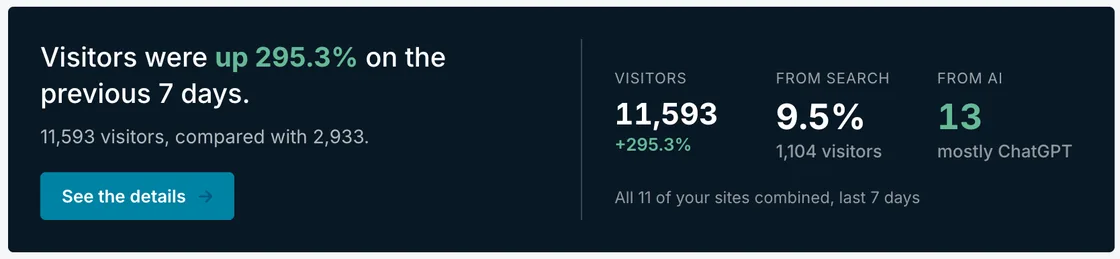
Once a day, the top of your dashboard picks one true and interesting thing about your traffic and says it in a sentence, with the figures behind it alongside. It changes once a day rather than on every refresh, so the number stays put long enough to trust.
From there, you can see:
- Visitors across your sites, compared with the previous period
- Where they came from: search, direct, social, referrals, email, and more
- Your most-read pages
- Visits from AI assistants, broken out by assistant, so you can see how many people asked ChatGPT, Perplexity, Claude, Gemini, or Copilot a question and landed on your site from the answer
That last one matters more every month. More and more people start with a question to an AI assistant instead of a search box, and until recently most organizations had no easy way to see whether that traffic was reaching them.
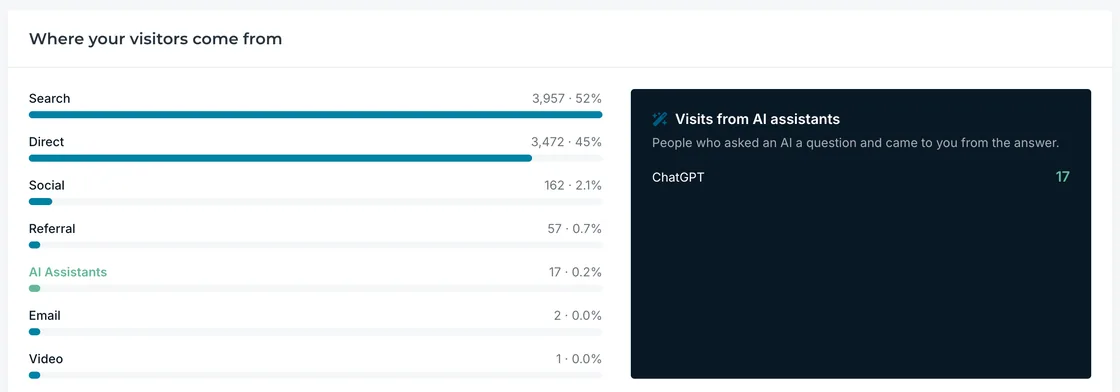
We also built DogHouse to handle these figures carefully. A site still collecting data shows no number rather than a zero. We suppress comparisons on very small numbers, because three visitors against one is technically a 200 percent rise and tells you nothing. I wrote more about those rules in our DogHouse 2.0 post.
Who Plausible is
We chose Plausible deliberately, and the company behind it is a big part of why.
Plausible was started in December 2018 by Uku Taht, and it is incorporated in Estonia. It is self-funded, with no outside investors, and is paid for entirely by subscribers rather than advertising. Its software is open source under the AGPL license, which means anyone can read exactly how it handles data. And your website's data is processed and stored in the EU, on infrastructure owned by European companies.
That independence is the point. Google Analytics is free because it is part of an advertising business. Plausible's only business is analytics, and it charges for it. We pay for an enterprise plan that covers our clients' sites, and that cost is ours, not yours.
Cookieless, privacy-friendly analytics in plain terms
Plausible measures traffic without tracking people. According to its published data policy:
- It uses no cookies, and nothing is stored in your visitor's browser.
- It collects no personal data and builds no profile of any individual.
- It does not track people across websites or devices.
- Raw IP addresses are never stored. To tell one visit from two, Plausible creates a one-way code from a random value, your domain, and the visitor's address and browser. That random value is deleted every 24 hours, so the code cannot be reversed or linked to the next day's.
What gets measured is the page visited, where the visitor came from, their browser and device type, and their approximate location (country, region, and city). Only in aggregate.
Because there are no cookies and no personal data involved, Plausible's position, backed by an independent legal assessment, is that its analytics do not need a cookie consent banner. That applies to this script only. Other tools on your site may still need one, and we are describing our analytics here, not giving legal advice.
It is also tiny. The Plausible script weighs about 2.5 KB when it reaches a visitor's browser. When we measured Google's tracking tag the same way this month, it ranged from about 150 KB to more than 190 KB depending on how the property was configured. On a phone, on a slow connection, that difference is real.
Plausible vs Google Analytics: which is more accurate?
You will hear that Plausible is "more accurate than Google Analytics" a lot. I want to be careful, because the truth is more useful than the slogan.
No two analytics tools ever agree. They define a visitor differently, filter differently, and see different slices of your traffic. If you run both, expect Plausible's numbers to differ from Google's, and often to be lower. Three things account for most of the gap.
Google Analytics bot traffic
More than half of all web traffic is now automated. Imperva's 2026 Bad Bot Report puts it at over 53 percent in 2025. Some of those bots run JavaScript and look like visitors to a basic analytics script. Plausible filters them out before anything reaches your dashboard: known crawlers, referrer spam, and roughly 32,000 data center address ranges.
We have seen this in our own numbers. When we audited our own website this summer, we estimated that roughly two out of every three sessions Google Analytics recorded were automated: sub-second visits, spread evenly across our sales pages, a couple of times a day, every day.
We saw it across our client sites, too. Before Plausible, DogHouse used a simple page counter we wrote ourselves, which counted every hit and filtered nothing. For the same 109 sites, that counter recorded about 800,000 pageviews in four weeks this summer. Plausible recorded about 558,000 in the four weeks after we switched, roughly 30 percent fewer.
That is not a perfect comparison, since the weeks are different and some visitors block analytics entirely. But it is exactly the direction you would expect when a tool starts telling people apart from scripts.
The smaller number is the truer one.
Cookie banners
If your site shows a cookie consent banner, Google Analytics does not record visitors who decline it. And many do: one study of real banner interactions found that more than 60 percent of users reject tracking when they are given a simple one-click "reject all" button.
Google can fill some of that gap with modeled estimates, but only for properties with enough traffic to qualify: at least 1,000 events a day from visitors who declined. Most small and midsize sites never reach that, so those visitors simply go uncounted. Plausible doesn't use cookies, so it doesn't depend on the banner, and it doesn't model or estimate. What you see was actually observed.
Ad blockers
Roughly 30 percent of internet users run an ad blocker at least some of the time, and Google's tracking script is one of the most commonly blocked addresses on the web. Plausible is blocked far less often. Safari and Firefox do not block it by default.
But I will not tell you it is never blocked, because it is. Strict blocklists, like the ones in uBlock Origin and the Brave browser, block analytics of every kind, Plausible included. A small share of your visitors will always go uncounted in Plausible, in Google Analytics, and in every tool like them.
So here is the claim I will stand behind. Plausible's numbers are not a perfect count of every human who visits your site. Nothing is. They are an honest count: filtered for bots, not estimated, not dependent on a cookie banner, and measured the same way every day. That makes your trends and comparisons trustworthy, even where the total is a modest undercount.
What we deliberately switched off
Plausible can record more than we ask of it, and our cookieless WordPress analytics setup is deliberately minimal. We turned the extras off on every site we manage: clicks on outbound links, file downloads, form submissions, and error page tracking. There are no session recordings, heatmaps, or scroll tracking anywhere in this.
We also exclude your own logged-in editors, so your staff updating pages doesn't inflate your numbers.
If you need conversion tracking or campaign-level detail, Google Analytics is the right tool, and you are welcome to keep it. This is the simple view, on purpose.
And if you would rather your site not be measured at all, just ask, and we will remove the script. We have already done exactly that for a client who preferred it. Your portal will show that we don't collect statistics for that site, and nothing else about how we look after it will change.
What this means for how we work with you
There is a second reason we did this, and I want to be upfront about it: it helps us do our jobs better.
FatLab has always been a technical company first. We keep sites fast, secure, updated, and online, and we do it well. What we have not always had is a clear, consistent picture of how each site is actually used:
- Which pages carry the traffic
- Whether search is growing or shrinking
- Whether AI assistants are starting to send visitors
- How much traffic a site handles on its busiest day
Now we have that for every site, measured the same way. It makes our advice more specific. When we talk with you about performance work, hosting capacity, or where to focus next, we can start from real traffic instead of guesswork. Over time, it will shape the technical services we build, because we will be able to see where our clients' sites genuinely need help.
"We have spent more than fifteen years looking after the machinery of our clients' websites," is how I would put it. "This is the first time we can see, across every site, how that machinery is actually being used. It makes us better consultants, and it means the advice we give is about your site, not websites in general."
Frequently Asked Questions
Do I need to remove Google Analytics?
No. Plausible runs alongside Google Analytics and any other analytics platform without interfering. Keep whatever your team uses today.
Why don't the numbers match Google Analytics?
No two analytics tools agree. Plausible filters out bots, doesn't depend on cookie consent, doesn't use modeled estimates, and is blocked less often by browsers. Expect the figures to differ, and often to be lower. The trends are what to watch.
Does this mean my site needs a cookie banner?
Not for this. Plausible uses no cookies and collects no personal data, and its position, backed by an independent legal assessment, is that no consent banner is required for its analytics. Other tools on your site may have their own requirements, and this is not legal advice.
Does this cost extra?
No. Analytics in DogHouse is included for every client we host. We pay for the Plausible plan.
Can I opt out?
Yes. Open a request, and we will remove the script from your site. Everything else about how we look after it stays the same.
Where do I see it?
Log in to DogHouse. Your traffic summary is on the dashboard, and each site's details are on the Websites page.